attention: ad (to, towards)+ tendere (stretch). To stretch towards.
Some years ago, I was captivated by a phrase:
What you pay attention to grows.
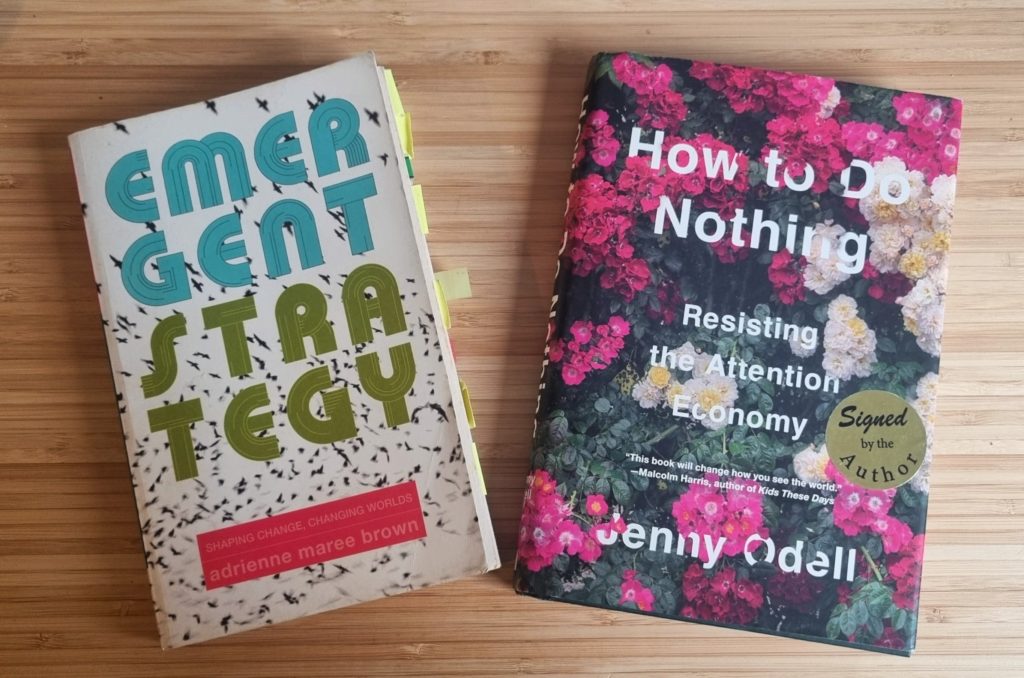
It comes from adrienne maree brown’s Emergent Strategy: Shaping Change, Changing Worlds and it is one of the book’s key principles. This idea felt so powerful in its implications that I started writing it down repeatedly in my journal and yearly intentions.
I’ve been holding this phrase close again lately, as I’ve been trying to pay attention to my attention: Where it goes and where it doesn’t. Why it so often feels like I have no control over it. How I can be more intentional in where I place it.
Attention has always felt tricky for me. I know I’m hardly alone. It is a topic on which so much has already been said – by writers and artists, productivity gurus, psychologists, scholars and many others. I’ve hesitated writing about it for this reason. My academic training tells me I don’t know enough about it. I haven’t conducted a thorough literature review.
But precisely because of that trickiness – and because our capacity for attending to what matters to us is so central to our experience of our lives and our creative practice – it is a topic I keep circling around. “To pay attention, this is our endless and proper work”, in the words of poet Mary Oliver.
I wanted to get curious about my own patterns of attention: to notice how my attention swirls and circles, homes in or is lost – and to ask myself what happens in these different moments, what feelings are present, and what they can tell me. With a more expansive question in the background: how can I harness my attention?
So, finally, I decided to write about it. Not from a position of expertise, but from a personal perspective – although my thinking, as always, is deeply indebted to and in conversation with that of others. I wanted to get curious about my own patterns of attention: to notice how my attention swirls and circles, homes in or is lost – and to ask myself what happens in these different moments, what feelings are present, and what they can tell me. With a more expansive question in the background: how can I harness my attention?
I ended up having quite a lot to say, so one blog post turned into a five-part series! The rest of this post expands on why this topic feels so important – and so deeply entwined with both creativity and justice.
our attention shapes the world
The idea that how we focus our attention shapes our world is so inspiring to me on both a personal and political level. I plastered brown’s emergent strategy principle all over my notebooks as a reminder to myself that I can choose what I give attention to and what I do not, and that, in this intentional everyday choosing, I have the power to shape (my) reality.
In How to Do Nothing: Resisting the Attention Economy, Jenny Odell offers a similarly powerful invitation:
[P]atterns of attention – what we choose to notice and what we do not – are how we render reality for ourselves, and thus have a direct bearing on what we feel is possible at any given time. (p. xxiii)
Of course, both brown and Odell are speaking to something more expansive than individual transformation, addressing the world-building capacity of attention on a collective level: together, by divesting from the trajectory of racial capitalist environmental catastrophe, we have the power to build new realities. We have the power to shape, change, seed, disrupt, disassemble our way towards something(s) altogether different, sustainable and interdependent.
Together, by divesting from the trajectory of racial capitalist environmental catastrophe, we have the power to build new realities. We have the power to shape, change, seed, disrupt, disassemble our way towards something(s) altogether different, sustainable and interdependent.
But collectives are made up of individuals, and the two types of transformation – individual and collective – are connected. If we don’t, as individuals, do our own personal healing work (part of which involves intentionally shifting where we put our attention), it is hard for us to come together with others for collective transformation.
brown writes and talks about this connection between individual and collective change a lot. In Emergent Strategy, she evokes the words of her mentor, Grace Lee Boggs:
Grace articulated it in what might be the most-used quote of my life: “Transform yourself to transform the world.” This doesn’t mean getting lost in the self, but rather to see our own lives and work and relationships as a front line, a first place we can practice justice, liberation, and alignment with each other and the planet. (p. 53)
Attention is so central to this kind of personal practice: what and who are we giving our attention to in our everyday lives? Who are we listening to? What are we noticing? What is not getting our attention? How does our attention show up in our relationships with the young people in our lives? With our neighbours and our local community? With nature and the more-than-human world? What kind of “work” (in a broad sense) are we attending to?
attention is political
Sadly, as most of us know, directing our attention is often easier said than done! Whether it’s getting stuck ruminating on things we would rather not give our attention to, or being unable to focus on the things we do want to do, our attention can be unwieldy and difficult to harness.
While our inability to pay attention in socially sanctioned ways (think: school, work, generally listening to and obeying our “superiors”) is often framed as a personal failing (or, in the case of ADHD, a disorder), attention is political. What are we being commanded to pay attention to and who decides?
Problems with attention are nowadays often chalked up to social media and the so-called attention economy. And, for sure, smart phones and social media are designed to hook our attention. I’m not planning to delve into debates on the harms vs benefits of social media here. But one thing I will say is that the attention economy is simply the latest iteration of a much older problem. Assaults on our attention are not new, but inherent to (racial, patriarchal, ableist) capitalism. It is only the technological means by which this occurs that have changed.
Having said that, these technological developments do matter. Their effects are unprecedented: the attention economy has enraptured us at a time of rapidly intensifying crisis for humanity. Odell lays out the dire consequences that face us in these times, again drawing the connection between the individual and the collective:
It’s not just that living in a constant state of distraction is unpleasant, or that a life without willful thought and action is an impoverished one. If it’s true that collective agency both mirrors and relies on the individual capacity to “pay attention”, then in a time that demands action, distraction appears to be (at the level of the collective) a life-and-death matter. (p. 81)
As part of this series, I will be thinking more closely about what and how we’re paying attention to what is happening in the world. This is something that I’ve been wrestling with on a personal level, as in the last few years I’ve found it increasingly difficult to pay attention to “the news”. I’ve chastised myself for this, as it has felt like a disengagement. But I wanted to dig a bit deeper, and I’ll be doing that in part 5, on when your attention refuses.
divergent attentions
Before wrapping up this first post, I want to touch on the relationship between attention and neurodivergence. From this perspective, there are additional angles and nuances to consider. This, of course, varies by our particular constellations of neurodivergent traits and many other factors (and I’m conscious I’m writing this as a non-ADHDer; I’ve not had my patterns of attention explicitly pathologised).
As a late-diagnosed autistic person, it’s been eye-opening for me to have this new lens through which to understand my attention. I have always known that I have a high level of attention to detail (a common autistic trait), but access to knowledge about topics such as monotropism, “special interests” (although I don’t love the term) and Marta Rose’s notion of “spiral time” has shifted so much shame about what occupies my attention and how (I’ll say more about some of this in the next post).
Being curious about my attention is by extension being curious about my feelings.
Post-diagnosis, I’ve been working on learning to trust my own body and feelings, something which I was very alienated from, and which is an ongoing process. I’ve come to see how connected my attention is to my feelings and that, therefore, being curious about my attention is by extension being curious about my feelings. While I don’t necessarily feel I can “trust” my attention, I can trust that it is telling me something about how I feel, which in turn gives me information about how to respond in different situations where attention feels in some way tricky. So, this is an experiment in curiosity and self-trust.
~~
In the next two posts, I’ll be exploring some different ways in which I have noticed my attention show up, first exploring “interested attention” (when I am paying close attention to something I am interested in) and, second, looking at “distracted attention” (when my attention is sucked into something I’d rather not be focusing on). In the fourth and fifth posts, I will be focusing on the flip side: when I want to pay attention to something but find it hard to do so. Specifically, I’ll be looking at how feelings of boredom and refusal show up for me and what they may be indicating.
I notice discomfort coming up around how much I’ve used the words “I”, “me” and “my” already in this introductory post. Part of me is questioning whether sharing these personal experiences of attention is in any way interesting or useful to anyone else. But my hope is that they may lead to some insight, thoughts or questions that are interesting beyond my own experience – and that they may in some small way contribute to ongoing conversations about how we can practise attending to what really matters in this moment. Perhaps they will even spark a similar experiment of curiosity and self-trust in you.
I’ll be posting a new instalment every fortnight or so. I would love it if you signed up to my newsletter – to be informed of when new posts go up and to continue the conversation.