There’s a pattern I’ve been noticing. It goes something like this: I’ll have a new idea for a creative writing project, get excited about it, do lots of research, write lots of notes, think about the idea intensely. So far so good. But then, when I try to start writing the actual thing, my attention flits off somewhere else, refuses to land and stay present – and the word “boring” suddenly enters.
I decided to get curious about this boredom. I’ve had a hunch that there is more to it than is immediately evident, given I’m pretty sure that not all my creative ideas are actually boring. When my conscious mind claims to be bored, there seems to be a shutting down happening, and I’ve started thinking about it as a kind of defence enacted by the conscious ego. In fact, I had a feeling that what was naming itself as boredom was not boredom at all. Having now done some reading about this emotion, it turns out that I both was and wasn’t right.
In this post, I’ll explain what I mean by that and unpack what might be going on when boredom shows up in our creative practice.
the boredom defence
In everyday life, we tend to characterise boredom as something mundane and listless, a kind of lifelessness almost. It is often associated with routine and repetitive tasks, such as doing housework or, to bring it into the sphere of writing, things like editing a reference list. Now, with my autistic attention to detail and monotropic focus, I actually love editing reference lists. And in another shocker: I quite like vacuuming, too. I seldom think “I’m bored” while doing these tasks. Boredom is clearly in the mind of the beholder.
But also, there seems to be some lack of clarity about what boredom is. In reading around on the topic, I came across a plethora of posts and articles that link boredom to creativity. You may be familiar with this line of thinking: we need to give ourselves space to be bored in order to spark our creativity. But in this reasoning, boredom is often flattened out to mean something similar to doing a monotonous task or even spending time not looking at your phone – in other words, allowing your mind to not be constantly occupied with external stimuli. But I would argue that these kinds of things don’t necessarily equate to boredom. They only equate to boredom if we actually feel bored.
But what does it mean to feel bored? Here’s where it gets interesting – and where I realised I was onto something in thinking that my sense of boredom was indicating something thornier.
In an essay in Granta, poet and psychoanalyst Nuar Alsadir writes:
From a psychoanalytical perspective, boredom is less a response to something in the external world than a defense against something in the internal world, an impulse or desire that is taboo – often sexual or aggressive in nature – which evokes guilt, anxiety, or fear of punishment.
Alsadir’s essay clarified so much for me! As I suspected, boredom is a defence. It’s an easily accessible emotion that puts up a barrier in our mind so that we don’t have to face what we truly desire – which often requires facing more vulnerable and challenging feelings.
I find Alsadir’s description of boredom as a state marked by restlessness so much more precise and accurate than descriptions of boredom that equate it with specific tasks. This restless state is caused by the repression of an unresolved desire: we know we want something, but we may not know what it is. And if boredom shows up when we are about to do something that we think we want to do, it is probably an indicator that we are scared of really facing that desire and what it may open us up to.
This restless state is caused by the repression of an unresolved desire: we know we want something, but we may not know what it is. And if boredom shows up when we are about to do something that we think we want to do, it is probably an indicator that we are scared of really facing that desire and what it may open us up to.
For those of us who feel deeply compelled to write, but for whom writing can feel difficult, there are probably some old wounds to face. I find this really useful to understand, and it means I can approach feelings of boredom with a little more gentleness and compassion. It doesn’t make them go away, but it leads me towards different questions around what the boredom is trying to protect me from feeling.
listening to boredom
But can boredom signal other things too, beyond avoidance or defensiveness? Perhaps sometimes that kind of restless dissatisfaction signals that something isn’t sitting right and we need to try something different – perhaps it is alerting us that something isn’t ringing true for us or aligning with our experience.
Staying with my focus on creative writing, I think that sometimes I have taken onboard craft advice or “rules” about writing that just do not work with my way of being and thinking, and trying to follow them can alienate me from my own sense of what could work.
For instance: a lot of fiction and creative non-fiction craft advice stresses the importance of including sensory detail and description. When I try to do this, I often notice boredom come up strongly. For better or worse, I am a person who is often very much “in my head”. Trying to describe an experience in sensory terms, rather than through what I am (or a character is) thinking often feels alien.
When boredom comes up in our writing projects, it may be giving us an important clue that we’re trying to fit into other people’s ways of thinking and being.
My boredom when describing sensory experience used to make me repeatedly come to the conclusion that I couldn’t really be interested in writing fiction or creative non-writing, despite my many ideas for stories, characters and creative essays.[1] I kept trying, but kept getting bored, then circling back to the same conclusion.
So imagine my excitement when I came across novelist Naoise Dolan’s essay “‘Show, don’t tell’ is broken”. Nolan critiques creative writing advice that dictates we must “show” emotions through description rather than through telling the reader what the character is thinking:
Certain readers seem to demand endless paragraphs on how the untimely death of a character’s chihuahua made their stomach clench. Personally I’m far more moved by descriptions of emotions expressed through cognitive realism rather than somatic signs: the stomach cramps could equally be attributed to an ill-advised third cup of coffee, while zooming in on each pixel of a character’s thought process can far more precisely reflect their experience.
Not coincidentally, I first read Nolan’s essay in its reprinted version in Someone Like Me: An Anthology of Non-Fiction by Autistic Writers. And it really was a moment of recognition for me: here was someone who was describing how she responds to literature emotionally not through descriptions of “flushed cheeks” or “shaking hands” but through detailed “cognitive description” and specificity. Yay!
Craft advice that’s reached the status of truism is so often written through a neuronormative – not to mention white, male and heterosexual – lens. When boredom comes up in our writing projects, it may therefore also be giving us an important clue that we’re trying to fit into other people’s ways of thinking and being. In these instances, we can pay attention, be curious and feel our way towards the kind of writing that most engages us – and that engages us in our writing. This can help guide us towards our own unique creative voices, interests and styles.
is boredom a prerequisite for creativity?
What about this argument that creativity requires boredom?
Now, I haven’t delved into the research, and I don’t want to make uninformed blanket statements, but I just wonder if we’re talking about something slightly different than boredom – or at least that boredom is only one part of it.
Perhaps we need to go back to the attention economy. It’s capitalist consumerist and productivity culture that tells us we need to be occupied every moment of the day and that if we’re not, we must be bored. We have learned to distract ourselves from our feelings; it feels easier to scroll [insert app of choice] than to sit down for five minutes without devices and notice what is happening inside of us. If the latter brings up feelings of boredom, that is more likely because we don’t want to feel whatever is arising. Boredom sits on top – perhaps we can call it a “surface emotion” – shutting down whatever is underneath, trying to bubble up.
It seems to me that what advocates of the “boredom leads to creativity” argument are talking about is simply the need for unoccupied mental space (which may or may not feel like boredom, depending on the person). There’s a reason people talk about having their best ideas in the shower or when they’re out walking. Doing a familiar physical activity (without at the same time listening to a podcast or the news or talking on the phone) allows the mind some breathing space.
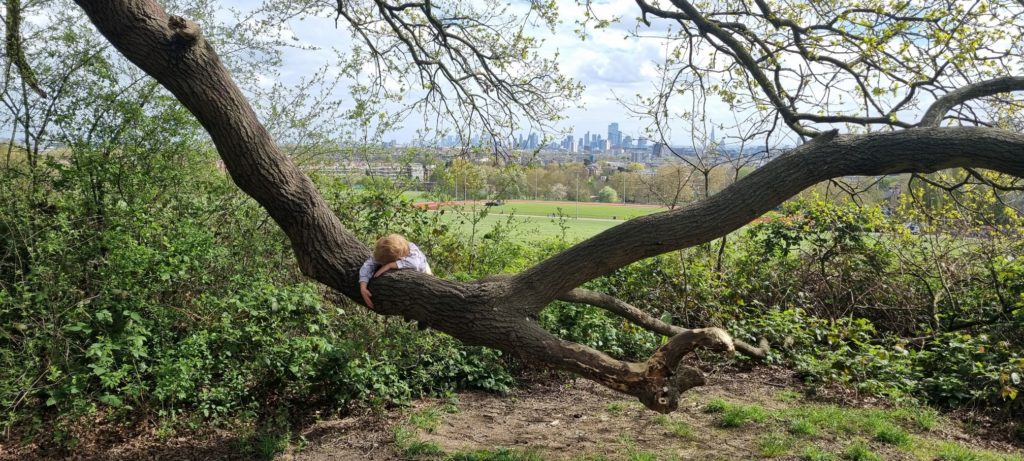
Of course, that space may get hijacked by anxiety and a rolling to-do list in our heads (and boredom may rear its head here), but that is why we need more space like this. In our hyper-consumerist culture, this kind of mind rest takes time to reach – there is a detoxing period to go through first. We can’t expect to have creative and expansive ideas as soon as we put our phone down – first we must face the defences that want us to pick it up again. For many of us, this is no small feat.
This makes me think again about Jenny Odell’s How to Do Nothing – specifically how she describes this lack of doing (and notice how she does not say “be bored”):
I want to be clear that I’m not actually encouraging anyone to stop doing things completely. In fact, I think that “doing nothing” – in the sense of refusing productivity and stopping to listen – entails an active process of listening that seeks out the effects of racial, environmental, and economic injustice and brings about real change. I consider “doing nothing” both as a kind of deprogramming device and as sustenance for those feeling too disassembled to act meaningfully. (p. 22)
It is this practice of letting your mind have space to pay deep attention to the world around us that leads to creativity and meaningful action. This involves, to return to Alsadir’s essay, “resolving” the boredom that may come up when we try to “do nothing” – we need to learn to sit with the boredom in some way and to welcome all that comes, so that it is possible to sense what is underneath. In my experience, that is not easy, but it helps to see more clearly (and thus prepare for) the fact that this may form part of the process of committing to a creative project.
meeting boredom with curiosity
In getting curious about boredom, this is where I have landed: boredom is (often) a defensive (or “surface”) emotion that is concealing more complex feelings. And when it surfaces in our creative work, it may be trying to protect us from facing the full force of our desire.
In other words, boredom is a fascinating emotion well worth paying attention to! Who knows what we may learn about ourselves, what we truly want and what we are capable of.
Thank you for reading part four in my series on attention! The three earlier parts are available here: listening to what our attention is telling us, honouring our passions and the distraction economy.
To be notified of future posts, you can sign up to my newsletter below.
[1] By “creative writing”, in this context, I mean anything beyond academic, technical and “reporting facts” types non-fiction. However, I do believe these forms of non-fiction can also be creative. I wrote more about this in an earlier post: is all writing creative?